


The Real Culprit: Ultra-Processed Foods
Copyright 2024 by Emmanuel González (aka J. Manuel González)
Background
For about the past sixty years (since the 1960s) the US has waged a misguided campaign against fats. This campaign was based on faulty statistical evaluation of various clinical studies conducted around the world, notably by cherry-picking countries whose trials coincided with the “Fat is Bad” hypothesis, while ignoring countries whose results contradicted. Even after allowance for some “good fats”, almost every authority in the US gave the same advice, which was to avoid cholesterol-rich foods like eggs and shrimp, cut out all saturated fats (meats, butter, fat-derived cooking oil like lard and tallow, coconut oil), and prefer monounsaturated and polyunsaturated fats (categories which lumped together olive oil, canola oil, Omega-3 oils from certain seafood, and others). Somewhat later, in the 1990s, trans-fats (partially hydrogenated fats) were also identified as highly detrimental to health, while olive oil was isolated as strongly beneficial.
As a result of the anti-fat campaign, food manufacturers and fast-food chains adjusted their products to reduce or eliminate the “good-tasting” fats like butter; beef and its oil, called tallow (formerly used by McDonald’s for frying French Fries); and pork and its oil, called lard (also called “shortening”). To compensate for the loss, they substituted additional carbohydrates, sugar, high-fructose corn syrup, various substances to improve texture, taste, and shelf-life; and they shifted to “vegetable oils” from tallow and lard. Most of these alternates and additives are what we would today call “ultra-processed foods”.
Simultaneously (and this is my own unscientific observation), Americans started eating much more, because the new foods simply were not as physically and emotionally satisfying. As parallel anecdotal evidence of this, it was claimed that a Twinkie (a kind of packaged cake snack) could be left 10 years at room temperature and would not spoil; this sounded good, until you stop to think that it didn’t rot because even bacteria wouldn’t or couldn’t eat it. McDonald’s sandwiches were similarly reported to last weeks in a refrigerator, leading to the same conclusion.
Many members of the food industry, the medical community, and government still demonize fat, but more progressive voices are sounding what in my opinion is a more valid alarm, against the ultraprocessed non-foods masquerading as foods, leading to obesity, all the metabolic and cardiac diseases, cancer, and liver and kidney failure, even among young persons.
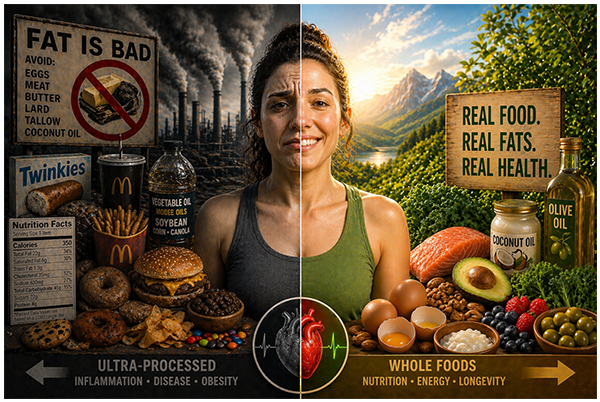
The Real Culprit
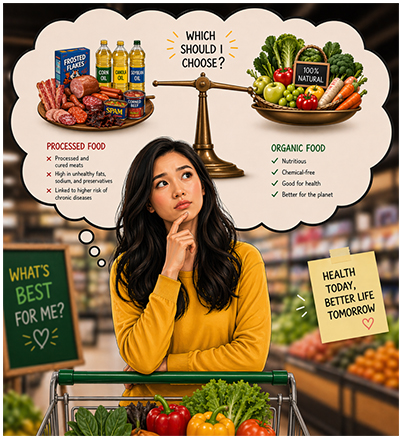
Consumers have been taught to value the terms “natural” and “organic”. Unfortunately, these terms are not tightly defined and policed. They should be.
The farther a food is from “natural”, meaning how much refinement, adding, subtracting, and transmutating is employed, the more “processed” it is, and the more likely it is bad for you because it lacks the original food value, undergoes chemical transformations, or adds harmful non-foods to improve texture, appearance, smell, shelf-life. Here is my personal suggested list of Minimally- Processed to Ultra- Processed foods, with explanations.
The following classifications are based solely on degree of processing. Not all less-processed foods are good for you. For example, carbs in all forms should be limited. Many canned products are high in sodium.
Minimally-Processed
- Fresh vegetables, fruits. Frozen leafy, legume, and cruciferous vegetables but not potato derivatives. Most vegetables and fruits were probably grown with some pesticides and some fertilizer, some traces of which may find their way into what you’re eating. “Organic” is generally good, but it depends on how that word is defined in your country, and what the product is; educate yourself.
- Brown rice and other whole grains, and breads directly made from them by you at home. Be wary of the label “whole grain”, unless it is “100% whole grain”. A “whole” grain has three parts; the outer covering (“bran”) is intact, and the germ and endosperm remain undisturbed inside.
- Most kinds of nut.
- Eggs. Their “high cholesterol” has never been proven to translate into cholesterol in your blood. See https://www.ncbi.nlm.nih.gov/pmc/articles/PMC7996514. Because eggs are satisfying and nutritious, in my opinion you are better off eating eggs than almost any other major protein source.
- Fresh or frozen meat. Most meat is from a farm of some kind, where the animal was probably raised with some use of antibiotics, vaccines, and hormones. There are some conjectures that hormones fed to chickens affect child development, but unless you are willing to go off the grid and raise your own barnyard animals, you will probably have to accept these. So-called “free-range” animals might be raised more humanely, and might have healthier (more natural) feed, but this term is also poorly-defined, so it is hard to put much stock in it.
- Fresh or frozen seafood, especially fish that you caught in the wild by yourself. (However, some species of fish have high contents of toxic metal; the higher up the ocean food chain, the more potentially toxic, such as mackerel, shark, swordfish, and bluefin tuna.)
- Natural cooking oils like beef tallow, pork lard, coconut, palm, olive, avocado, or peanut, of the type that can be extracted by cold pressing without involving any chemical processing except heating. Also butter, ghee. Most other cooking oils are Ultra-Processed. (Note: palm oil comes mainly from plantations clear-cut out of tropical rainforest, and is not considered a “green” choice.) Still, avoid too much deep-fried food.
- Mayonnaise home-made with olive or avocado oil.
- Honey. Alternative sweeteners which are close to natural, like stevia, monk fruit, and xylitol.
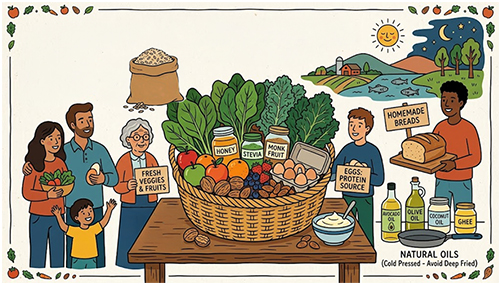
Moderately-Processed. Still mostly okay.
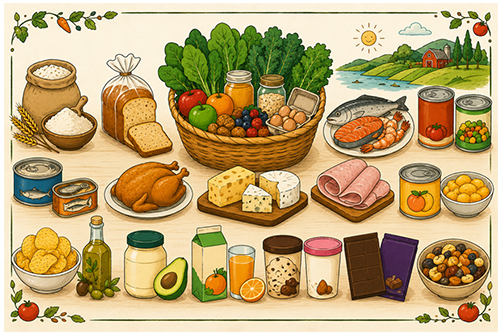
- Most flours and baking products. Grains are usually crushed and milled, separating the bran and germ to make white flour.
- “100% Whole grain” breads bought in a grocery. These have more fiber and nutrients than “white” bread, but only if “whole grain” (those exact words, whole + a grain, e.g., whole wheat, but not just any wheat bread). Multi-grain is often just white bread made with different kinds of incomplete grain (wheat, rye, etc.), and caramel color.
- Sugar (sucrose, but not any other sugar-like chemical such as high-fructose corn syrup, fructose, dextrose, glucose, maltodextrin, etc.) regardless of its color. (Most brown sugar is just white sugar with some molasses left in or added back to fool the consumer — not any healthier than white sugar.) But sugar is bad for you for other reasons.
- Most farmed fish is okay in moderate quantities. This includes Norwegian salmon, Philippine bangus, tilapia, prawns. However, note that farmed fish are fed unnatural diets to make them grow faster.
- Retort-canned soups and vegetables, including tomato derivatives, legumes, mushrooms, etc. Sodium, sugar, coloring, and preservatives are often added. “Retort-canned” means the contents were cooked, vacuum-canned, then heated several hours at about 120–130° Celsius to sterilize. Home-made canning and bottling do not qualify as retort.
- Retort-canned meat stews, tuna, sardines, etc.
- On-site-cooked meats (e.g., roast chicken, pork belly) sold hot in groceries.
- Cheeses sold “fresh” (e.g., cut in front of you from a whole wheel), rather than factory packaged for sale in groceries, which have extenders, preservatives, and non-food ingredients.
- Mild delicatessen hams like Virginia, but not hard or long-cured hams, and not most other deli meats.
- Canned fruits are relatively less-processed, but are mostly not as healthy as you would think, because they almost always have added sugar or high-fructose corn syrup.
- Potato chips if cooked in olive or avocado oil.
- Store-bought mayonnaise if made 100% from olive or avocado oil.
- “100% natural fruit juice, with no sugar added” (must be so labeled). Fruit juice described merely as “natural” almost certainly has bad forms of sweetener added, as well as cancercausing food coloring.
- Higher-end ice creams (examples are Ben and Jerry’s, and Hagen Daz), made with sugar and not HFCS.
- Diet ice creams, if NOT labeled “reduced-fat” or “no/low sugar”, because to compensate, the manufacturers probably added unhealthy ingredients for flavor and texture. “Non-dairy” ice creams may be okay, if the replacement for the dairy is coconut milk/oil.
- Higher-end chocolate bars/candy like Lindt and Cadbury, which are made with relatively more natural ingredients and few or no unhealthy additives. European-made chocolates tend generally to be of this type. Nonetheless, it is easy to binge on chocolate or worse kinds of candy (such as hard candy, which is just sugar with a little flavoring); try not to eat too much. There are some claims that European candies have lead. Do your own research.
- Trail mix, provided the “cheap candy” component is low.
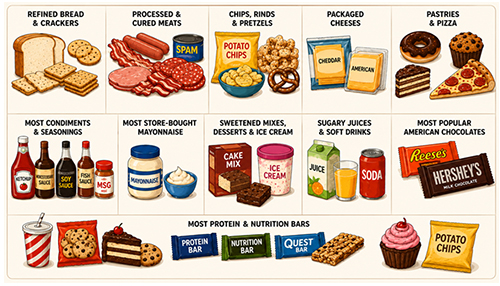
Highly-Processed. Limit consumption to a few times monthly, or to small quantities.
- Any bread not labeled “whole grain/wheat/rye/etc.” Includes white bread, multigrain bread, soda crackers, Ritz crackers, Graham crackers, etc.
- Processed and cured meats. These are generally low-quality parts of the animal and almost all have nitrate preservatives, sugar, food coloring, numerous non-food ingredients designed to improve flavor or extend shelf life, and fillers to “stretch” the meat. This category includes bacon, long-cured ham, hot dogs, sausages, salami, pepperoni, other cold cuts (even turkey), Spam, canned corned beef, jerky.
- Supermarket pork rinds (chicharron), hard American pretzels, most real potato chips (not Pringles) if not heavily flavored. But not good for you anyway, being “empty calories”.
- Cheeses packaged for sale in groceries.
- Most pastries that you can buy newly-cooked in a bakeshop (not belonging to a chain). But not good for you, being mostly empty calories. Pizzas from a pizza parlor, because most of the ingredients are moderately or highly-processed.
- Most condiments — ketchup, Worcestershire sauce, soy sauce, fish sauce, Maggi seasoning, Aromat, MSG additives. Contrary to common opinion, MSG is a fairly natural product, derived from vegetables, and is naturally found in tomatoes, carrots, soybeans, others. In small quantities, should not be problematic.
- Most store-bought mayonnaise that isn’t made with olive or avocado oil.
- Any other food that contains relatively large amounts of HFCS or similar, such as cake mixes, cheaper brands of ice cream (like Baskin Robbins), packaged desserts and baked goods.
- Fruit juices and soft drinks sweetened entirely with sucrose from cane sugar (not any other kind of sugar or HFCS).
- Most popular American chocolates, such as Reese’s and Hershey’s, which contain HFCS or other sugar substitutes.
- Most protein bars and nutrition bars. They often contain additives, artificial sweeteners, or unhealthy kinds of vegetable oil. However, those which provide significant fiber while limiting calorie content may be “worth the disadvantages” if they help control weight, ward off cravings, and improve digestive regularity. An example of this is Quest bars.
Ultra-Processed. Cut out altogether or severely limit.
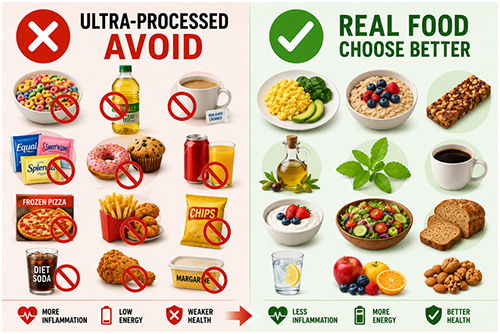
- Find alternatives: Almost all breakfast cereals, which have been bleached, dyed, deodorized, texturized, de-fatted, reconstituted, stripped of most nutrients except calories, and contain back-added HFCS and preservatives. Possible exceptions are the very-high-fiber types, which at least have fiber, though they too have mostly stripped and discarded the vitamins, minerals, trace elements, and phytonutrients that may have been in the original source grain or fruit. Breakfast cereals are popular as time-savers, but pre-boiled eggs, leftovers of nutritious meals, and some protein bars are good alternatives if short on time in the morning.
- Cut out altogether, since there are reasonable alternatives: Almost all vegetable cooking oils, such as corn, sunflower, canola, soybean, peanut, safflower, etc. All of these are manufactured through complex chemical processes for filtering, bleaching, deodorizing, and thickening or thinning. The resulting oils are unstable and quickly degrade into trans-fats when heated.
- Cut out altogether where possible, since there are reasonable alternatives for sweetening coffee and the like: all synthetic sweeteners like aspartame, Equal (contains aspartame, dextrose, and maltodextrose — all fairly bad), Splenda/sucralose, Sweet and Low/saccharine, etc. Prefer allulose, stevia, monk fruit, or xylitol (with no other ingredients). (The -tols are sugar alcohols and sort of natural, but not 0 calorie, and recently implicated in certain health risks, but probably not in the small quantities used for sweetening coffee.) Table sugar is not so bad if you can educate your mouth to be content with small quantities, such as ½ teaspoon which is 8 calories, 2 grams net carbs.
- Avoid completely: non-dairy creamers, which all contain trans-fats; alternative milks like soy and almond, which have very little saturated fat but lots of starch and sugar to compensate for the loss of eating satisfaction (and most alternative milks actually have very little of the claimed “soy”, etc.
- Cut out altogether: all bakery-type goods (not previously-mentioned) that you can buy in a grocery store, chain bakeshop, or chain restaurant, such as frozen pizza, doughnuts, muffins, cookies, snack cakes, etc. Instead bake your own, or at least buy freshly-made from a local bakery.
- Severely limit: any soft drink or fruit juice, or any other product, with High-Fructose Corn Syrup (HFCS), or any other form of (or seeming synonym for) sugar such as dextrose, maltodextrin, agave, fructose, fruit fructose, maize syrup, glucose, corn sugar, etc.
- Severely limit: diet drinks, which are all made with combinations of synthetic sweeteners. If you have to choose between diet and regular drinks, choose either but keep the daily consumption down.
- Severely limit: Anything you can buy in a fast-food restaurant, or large restaurant chain. They all use the harmful kinds of vegetable oil (see above) for frying, and keep using it multiple times. They almost all add non-nutritive ingredients to the food, as well as large amounts of salt and sugar (in whatever form).
- Severely limit: Anything deep-fried from any source, unless you fried it yourself in a natural oil like coconut, olive, lard, tallow, or butter (see Minimally-Processed list above).
- Severely limit: Any form of chip or snack food other than simple real potato chips (which should also be fairly limited) and hard pretzels. This includes Cheetos, taco chips, heavily-flavored potato chips, Oishi, etc.
- Be very wary of: anything marketed as “zero sugar” or “low/reduced fat”. Read the ingredient list carefully for signs of HFCS or similar, or other questionable ingredients.
- Margarine and products containing large amounts of trans fats.
Extra
If you’ve spent a lifetime eating unhealthy ultra-processed foods, you’re at risk for many kinds of cancer, cardiovascular disease, diabetes, and kidney and liver failure. Typical multivitamins won’t do much for you, but among less-well-known remedies, consider high doses of these: Vitamin K2, Resveratrol, berry-derived phytonutrients, betaine, and nattokinase. All have some clinical studies supporting the idea that they support heart and metabolic health and lower the risks of cancer, through various mechanisms.
We suggest our own Plantation Bay’s Keto-but-Not-Kwite Diet (found in the Resources section of Wellness on www.plantationbay.com) which is a combination of low-carbohydrate and Intermittent Fasting diet approaches. It’s not yet clinically proven in humans, but either or both may help slow cancer progression through different processes of starving cancer cells of glucose nutrient and autophagy (self-dismantling of damaged cells).