Intermittent Fasting – a New Old Way to Eat
A Natural Aid to Weight Loss, Blood Sugar and Lipid Control, and Possibly Many Other Benefits
Management is always interested in the health and welfare of our staff. Periodically, I share health ideas which may be helpful to some.
Do you have any of these conditions?
- High blood sugar or active diabetes
- Overweight
- High cholesterol or triglycerides
- Impaired kidney function (but not end-stage renal failure)
Then you should read this and consider if you want to try Intermittent Fasting (IF), which is basically a pattern of skipping meals and snacks for 16-36 hours (including time asleep), while ingesting only non-caloric beverages. It can be done once, twice, or thrice a week, while you eat normally outside the fasting periods.
Before you tell yourself you don't have the will-power to fast, keep reading, and see how easy it is to follow some fasting strategies.
Get medical advice before doing a longer continuous fast, or more frequent fasts, or if you are taking any medications which directly affect insulin production (sulfonylureas or insulin itself, but not Metformin or SGLT 2 inhibitors). Pregnant women, children, and those with certain nutritional deficiencies probably should not do IF. Nor is IF safe for those with Type 1 diabetes (a genetic inability to make insulin at all).
Scientific Basis for Intermittent Fasting
The theory behind Intermittent Fasting (as opposed to simply watching calories) is that any food you eat requires processing effort by your organs. Specifically, eating triggers the release of insulin, which is needed to help cells absorb glucose from your blood, as well as to process fats and proteins.
Insulin resistance is what happens when your cells "get sick and tired" of being bombarded with insulin, so they react to it less and less. The medical approach, up to recently, has been to find ways to make more insulin in your body, or to inject it. Though this lowers your blood sugar, it actually makes your long-term problem worse. If your weight or diabetes problem is related to insulin resistance (almost everybody's is), a steady, spread-out pattern of eating, and therefore steady release of insulin, only creates more resistance.
From the point of view of losing weight, while your body is secreting insulin (or if you are injecting it), the signal your body is getting is "food is being delivered". Therefore the processes by which body fat is burned do not turn on. Here are illustrations of insulin release over the course of a day, in response to different eating patterns.
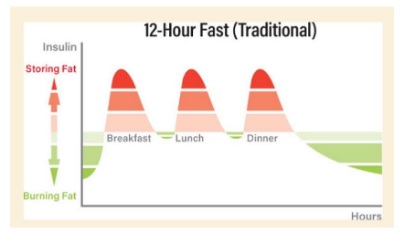
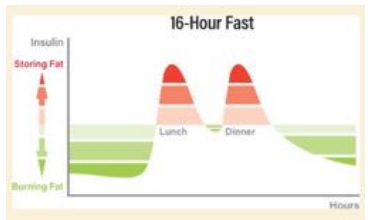
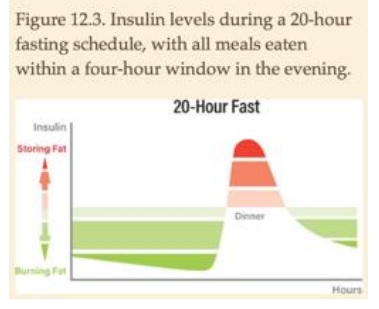
To get out of the vicious cycle, Intermittent Fasters claim, you have to give your body a total break from insulin release, for periods of 16 hours (beginner) or longer (36 hours and up). "Total break" means almost no caloric food at all, and especially not little snacks; you can drink black coffee, tea, and (if you have to for your sanity) some diet soda. Soup made from simmering chicken or beef bones is okay (plus a little salt, but no solids), but even this is better to avoid.
16 hours is not as hard as it sounds. Eat a normal dinner the previous night (finishing by 8 pm), skip breakfast, then eat a normal lunch (start after 12 noon), and eat a normal dinner. If you do this, it would need to be several times a week to have any effect
Difference from Other Diets
Most diets fail because by merely reducing calorie consumption, we train our bodies to burn less calories (lower our metabolic rate). This is the so-called "starvation effect", which kicks in when our bodies realize that over an extended period your calorie intake is down; the body concludes that there is a long-term food shortage and adjusts metabolic burn down.
But by fasting intermittently (even just skipping one or two meals), we curtail insulin release, which allows our bodies to burn fat reserves more easily, maintaining a high metabolic rate. This is actually conceptually an extension of the Paleo Diet concept, which urges us to eat hunter-gatherer foods rather than cultivated foods and livestock. It is quite unlikely that our hunter-gatherer ancestors ate three square meals a day. More likely, they feasted when they bagged a boar, then went hungry for a day or two until they found a berry bush to tide them over until they could find more game. It is quite probable that Intermittent Fasting was in fact our ancestral mode of eating.
Flexible Fasting Patterns
You can choose a fasting regime which matches your lifestyle and your personal situation. The most common strategies for Intermittent Fasting are:
Skip Breakfast most days (16-hour Fasting Period). This means eating a normal dinner (finish by 8 pm), then the following morning eat nothing until starting a normal lunch at 12 noon. It is claimed that you will lose weight not only because you are simply consuming fewer calories, but also because you have given your body a break from constant release of insulin. If you have only moderate weight or blood sugar issues, this might be enough. But eat "nothing" should be taken close to literally.
By the way, it has long been held that "breakfast is the most important meal of the day", so it was important to eat a full breakfast to "get the metabolism moving". I myself believed this, which is why we're the only hotel in the world with a daily-changing breakfast theme, and a separate breakfast diner. However, it has now been pointed out that many nationalities which hardly eat anything for breakfast (French, Spanish, Japanese) are less overweight and less prone to heart disease than those nationalities which eat hearty breakfasts (Americans, Canadians, British, Filipinos). Though skipping breakfast may initially make you feel a little less energetic, this may not happen after you get used to it.
22-Hour Fasting Period (once, twice, or three times a week). The easiest form of this is to finish dinner by 8pm; the following day, do not eat until dinnertime, around 6 pm. The day after, eat normally (try not to overeat to compensate for the meals missed).
5:2 Fast (a weekly pattern, 5 days normal eating, 2 days fasting). Choose two days a week when you will under-eat, for example, Monday and Tuesday (better in sequence if you can stand it, but okay if not). On those days, from the time you wake until the time you go to sleep, you can only consume 400 calories (women of average Filipino size), up to 600 calories (larger men). These calories should preferentially be fats and proteins, because carbohydrate or sugar, with a high glycemic index, will trigger a blood sugar spike, then a hunger response a few hours after.
Here are some examples of things you could choose to eat within your 400-600 calories on fast days: hard-boiled egg (80 calories, no carbs); one tablespoon of peanut butter (100 calories, mostly mono-unsaturated fat, some protein, no carbs); small slice of cheese (110 calories, mostly fats); half a large baked chicken breast, without skin (150 calories, mostly protein); a stick of dried beef or pork (about 100 calories of fat and protein depending on the brand); al
Long-Term Outcome. Some studies suggest that the 16:8 schedule is the easiest to stick to long-term, and
for that reason probably the best choice for most people.
What Can You Eat During a Fasting Period?
- Water or plain soda water.
- Coffee or tea (without sweetener or milk/creamer of any kind, not even Stevia or Coffee-mate). Herbal teas. NOT canned tea, which is sweetened.
- If desperate: diet soda.
- If desperate: bone broth. Take if the only alternative is a breakdown of willpower leading to your eating carbohydrate or solid protein (e.g, even an egg), but avoid if you can muster enough will-power to last through the day.
- Fiber provided it doesn't come with net carbs. "Net Carbs" is the term for the carbohydrates in a given food that aren't fiber or sugar alcohol; sugar alcohols like erythritol, maltitol, and xylitol are forms of alcohol that taste sweet; since alcohol doesn't require insulin to be metabolized, within reasonable bounds they don't break a fast. Also Psyllium husk powder, and fiber gummies made
with inulin, pectin, or soluble corn fiber. Technically a 6-capsule Psylliumserving has 10 calories/3 grams fiber, and each inulin gummie has 5 calories/2 grams fiber but if it's all fiber you can't digest any of it, so it's okay. However, if you find that your IF isn't working, try eliminating the fiber and see if that helps. - Prescription medicine if it can be taken on an empty stomach. For medicines which should be taken with food, try to establish a schedule which allows them to be taken after your fasting period. If your medicine needs to be taken twice a day, or if you are doing a fast longer than 24 hours, consult your doctor.
- Certain supplements, such as Metformin, aspirin, Curcumin, Quercetin, Reishi, Pomegranate, Resveratrol, Cod Liver, Green Tea, R-Lipoic Acid – can be taken while fasting. All these inhibit mTOR activation (see below, Autophagy) and have very few calories and no protein.
What Should You NOT Eat During a Fasting Period?
- NO food in a quantity that has more than trace calories, whether carbohydrate, fat, or protein. For most sedentary people, "trace" means a total of less than 10 calories from fat and protein throughout the fasting period, or 2 calories if carbohydrate or sugar.
- Except those noted above, NO nutritional supplements with more than trace calories. The Forbidden list would thus include Omega-3, Co-Q-10, and any supplements in an oil base (usually in the form of gel capsules).
- NO collagen, protein, or other powders with nutritional content.
- AVOID sweeteners of any kind, including zero-calorie artificial sweeteners like sucralose in diet drinks, and "natural" ones like stevia, monk fruit, sugar alcohols (erythritol, mallitol, and the like) and of course sugar. The sweet taste sends a signal to your body that food is coming, so insulin may be released anyway (like Pavlov's salivating dog, in anticipation).
IT IS ABSOLUTELY VITAL THAT YOU DO NOT CONVINCE YOURSELF THAT a few chips or a cracker every now and then are okay.
What Can You Eat on Non-Fasting Days/Periods?
Anything! But easy on the carbs. As in many other diet concepts, sugars (candy, ice cream), starches (potatoes), grains (rice, corn products) and refined carbohydrates (bread, cake) should be reduced as much as possible, while maintaining a high fiber intake through leafy vegetables, some kinds of fruit (apples
rather than mangoes), and psyllium/inulin. But you can enjoy some of these on your non-fast days, because will-power is finite and if you abstain altogether, you might binge later
In the Intermittent Fasting approach, fats are okay outside the fasting period. Olive oil, avocado, nuts, eggs, and other "good" fats are better, but animal fats are okay within reason. All fats are satisfying physically and emotionally, and help avoid binging. There is now ample evidence (not just from the Intermittent Fasting community) that the US Government and American Heart Association campaigns (starting in the 1960s) to lower consumption of saturated fats has been misguided; the more successful people were in reducing fat intake, the more carbohydrate, sugar, and other unhealthy stuff they ate to compensate.
Maintain a supply of non-sugar sweets or meal replacement bars that have few net carbs. You can use them if you develop a sudden craving. But try not to give in on a regular basis.
Autophagy
Aside from giving your body a break from insulin, intermittent fasting also puts your cells into a condition called Autophagy ("self-eating"). When you eat regularly, your body goes into and remains in "cell-building" mode as it tries to take advantage of the availability of nutrients. Cell-building mode is activated by an increase in a protein called m-TOR, which in turn is caused by ingestion of almost any food. In simple terms, m-TOR is needed by your body to build cells, but too much, too long, is bad because your body also needs to repair and restore, i.e., break down cells.
It takes about 16 hours of fasting before your m-TOR drops and your body goes into "cell scavenging and recycling" mode, called "autophagy". By a process which isn't yet fully understood (a Nobel Prize in Medicine was awarded only as recently as 2016 for discoveries in autophagy), your body identifies and breaks down old or poorly-functioning cells so that they can be used for fuel and later replaced with "new parts". In brief, autophagy is a beneficial process which allows your body to repair and rejuvenate itself. It might play a role in avoiding degenerative diseases and cancers.
According to current best estimates, autophagy remains beneficial for about 1-3 days of fasting. (After that, healthy cells might be scavenged.) This is an argument in favor of alternate-day 22-hour fasts.
Ketosis and Brain Function. When your blood runs out of glucose (what carbs and sugars turned into upon digestion), your liver starts burning stored fat, turning it into ketones. These are only two ways energy is delivered to your cells — glucose or ketones. There is some recent evidence that maintaining a constant state of ketosis through a combination of a Keto Diet and Intermittent Fasting is beneficial for brain function. It is probably very helpful in slowing cognitive decline.
However, strict clinical trials are unlikely because drug companies would make less money by proving this hypothesis; they would rather you kept eating carbs so they can sell you statins and diabetes drugs.
Claimed Benefits of Intermittent Fasting aside from Weight Loss and Improved Insulin Sensitivity
There is anecdotal evidence that IF can in some cases:
- Detoxify the body, enhancing youthful functioning of cells, rebuilding damaged cells (Autophagy).
- Avoid cancer or enhance cancer survival rates (in combination with chemotherapy)
- Control diabetes and lipid profile to the extent that medication is no longer needed. See https://www.businessinsider.com.au/men-type-2-diabetes-stopped-insulin-intermittent-fasting-study-2018-10
- Reduce inflammation, blood pressure, and other expressions of heart disease
- Boost brain function, alleviating Alzheimer's symptoms, improving memory and alertness
- Promote longevity, not just lifespan, but healthy lifespan. See this report from Harvard:
https://news.harvard.edu/gazette/story/2017/11/intermittent-fasting-may-be-center-of-increasing-lifespan/ CNN said: https://edition.cnn.com/2018/10/01/health/fasting-longevity-food-drayer/index.html
Google "intermittent fasting" to learn more about this concept. And consider giving it a try before just automatically saying that you're not capable of it. Many doctors, also, will automatically reject any idea they're not familiar with; some of them still say eggs are bad for your cholesterol, even though this idea has been soundly disproven. So if your regular doctor isn't on board with even a modest IF or Keto Diet program for you, ask around for someone who is. More and more of the top doctors in the world are endorsing Intermittent Fasting:
The Cleveland Clinic is the top heart hospital in the US, and has this to say:
https://health.clevelandclinic.org/interested-fasting-health-get-facts-first/
After viewing IF dismissively in earlier years, Harvard did a U-turn in 2018 and said this:
https://www.health.harvard.edu/blog/intermittent-fasting-surprising-update-2018062914156
Let's all lead healthier lives and have more fun while we're at it!