


Plantation Bay Recommendations on Food and Nutrition
January 2026
AVOID WHENEVER POSSIBLE or CONSUME SPARINGLY
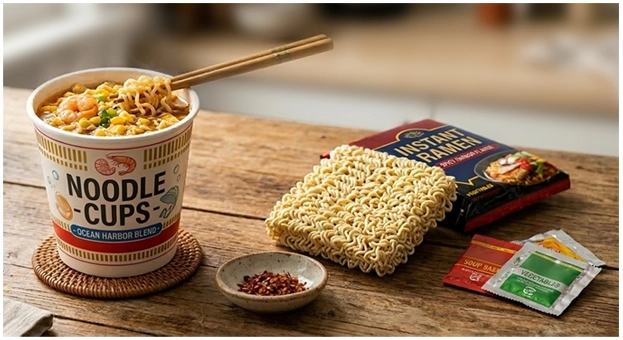
Instant noodles:
consist almost entirely of calories (about 350) from carbohydrates, plus sodium, with very little fiber (2% daily requirement) or protein (7 grams, same as one egg), lacking in minerals and phytonutrients. The danger is that if you take these too regularly, you will be malnourished. Also consider why even after several hours, the noodles don’t soften. Know any real food that behaves like that after water immersion? Do you think your stomach and intestines recognize it as food?

Anything a Fast-Food Restaurant Sells.
Ultra-High Processed, fried in Trans-Fats, high in carbs and hidden sugars.
- Anything that lists Modified Corn Starch as an ingredient. (Sneaky alternate terms: Acetylated starch, Starch sodium octenyl succinate, E1420, E1450, Maltodextrin, Corn syrup solids, Modified food starch, or just Starch.) These are industrial texturizers or bulking agents, whitened with bleach, non-nutritive except for calories, and Ultra-high Processed.
- Conventional Chocolates and Candy are high-calorie, high-glycemic, and consist mainly of fat and sugar. Have an occasional treat, but avoid a daily habit. (Dark chocolate with less sugar and milk provides beneficial flavonols.)
- Seed oils (cottonseed, soy, canola, corn, sunflower, etc.) are Ultra-High-Processed, may contain residual chemicals from the manufacturing process, and quickly turn into Trans-Fats. Switch to natural coconut oil, which costs more but can be used more times. Palm Kernel Oil is a seed oil; Palm Oil (if correctly labeled) is not, but it’s not as good as coconut oil made from actual coconuts, and it’s not environment-friendly, usually grown by clear-cutting virgin jungle.
- Margarine is already a Trans-Fat. Many Filipinos and some Americans take margarine in the belief it is healthier than butter, which was demonized as a saturated fat. WRONG. (Margarine is the flavoring in ensaymada, by the way.)
- Sugar-sweetened soft drinks and fruit juices. Once or twice a week, perhaps, but not with every meal. Parents often believe “fruit juices” are good, but they are just soft drinks with a different taste. Most are artificially-flavored, but even those directly derived from real fruit have a high glycemic load and lack the fiber of whole fresh fruit.

Baked and fried goods sold in a supermarket,
meaning cake, cookies, doughnuts, pizza — anything of this type cooked in a factory, or whose dough/batter was made in a factory, or sold in a chain bakery, or that you can buy in a supermarket. All have chemical preservatives and ingredients designed to make you crave more by triggering a glycemic rush. Especially avoid snacking.

Processed Meats
(bacon, hot dogs, sausages, cured ham, precooked turkey, ham, and beef, etc.; also Spam, corned beef or ham in cans, etc.) contain many chemicals foreign to our bodies. Anecdotally associated with colon and other cancers, obesity, kidney and liver damage. Limit to a few servings a week, certainly not a full portion daily. Be self-aware: a little Spam, a little bacon, a hot dog — can add up fast in a week, and if maintained over many years are certainly detrimental.

Alcohol
is a poison, but so are doughnuts and charbroiled steaks. Choose your poisons wisely. There is some clinical evidence that about 15 ml of alcohol as a daily average is actually beneficial for persons over 40, provided there was no binge-drinking in earlier years and no resulting kidney damage. 15 ml of alcohol translates loosely to 1 can of 5% beer, 1 shot of 80-proof spirits, or 1 glass of 12% wine. Double this is probably okay if you regularly check your kidney function, are in good health, and have no family history of kidney failure. Triple this is asking for trouble at any age.
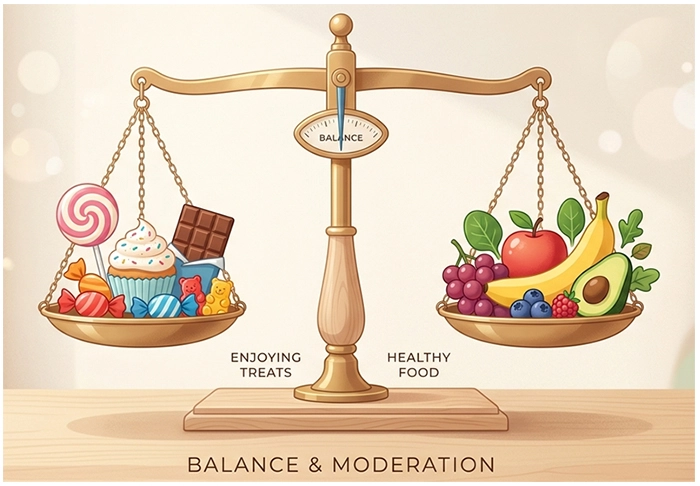
ENJOY IN MODERATION
- Beef, Pork, Lamb, including the fat. The anecdotal evidence is clear: once Americans demonized saturated fat and replaced it with artificial ingredients, industrial-strength starches, and non-natural sugars, obesity and metabolic disease shot up. A satisfying ribeye with plenty of marbling is better for you than a “0% Fat” cookie that leaves you unsatisfied and which you therefore will wind up overeating.
- Potato Chips (and other similar potato or corn-based snacks) once or twice a week in moderation, but not if you know you are a binge-eater. If so, you need to avoid chips altogether. Frito-Lay’s advertising was meant for you — “Bet you can’t have just one.” For binge eaters, this really means “Bet you can’t have just one 4 oz. bag.”
- Hamburger and Sausage, but only if home-made or made by a responsible establishment like Plantation Bay, which uses no extenders or preservatives.
- Cakes and Pastries from a Single-Outlet Bakery Whose Owner-Baker You Can Meet. Ice Cream after you have carefully studied the ingredients. Single-outlet bakeries generally serve freshly-baked products with no preservatives, texturizers, or bleaches, But interrogate the owner-baker anyway. If you can’t meet the owner-baker or a responsible manager, you should pass on that bakery. As for ice creams, many contain maltodextrin, which has a glycemic index of about 100 and is therefore practically toxic. Also avoid ice creams which are both “low fat” and “diet” because Plantation Bay has tried, and you really can’t have both; if low fat, it needs texturizers and more sugars or starches which raise the calorie count; if “diet” it necessarily gave up the fats, so it will be tasteless, so why bother? Plantation Bay has ice creams which are both “dairy-free” and relatively “low-calorie”; that’s as good as you’ll get in a “healthy” ice cream. Go for taste and texture like we do, and you’ll be satisfied with less.
- Butter is a great flavoring for many foods, and a little goes a long way. It was widely dis-counseled for the past 50 years along with the demonization of all “saturated” fats, but no relationship has ever been proven between high butter consumption, or for that matter saturated fat consumption, and mortality. For the full, sordid story of how the entire world was fooled with false data, read Plantation Bay’s article The Swindle of the Century (also in Resources) or have a look at this US Government research article: https://pmc.ncbi.nlm.nih.gov/articles/PMC9794145. An excerpt:
“These trials provide surprisingly little support for the diet-heart hypothesis. Dramatic reductions in the consumptions of saturated fats had successfully lowered the participants’ cholesterol, by an average of 29mg/dl, ‘indicating a high level of compliance’ among subjects, according to one analysis [16], yet the expected reductions in either cardiovascular or total mortality were not observed in most trials [15]. In other words, although diet could successfully lower blood cholesterol, this reduction did not appear to translate into long-term cardiovascular gains.”
NOT AS GOOD AS YOU THINK
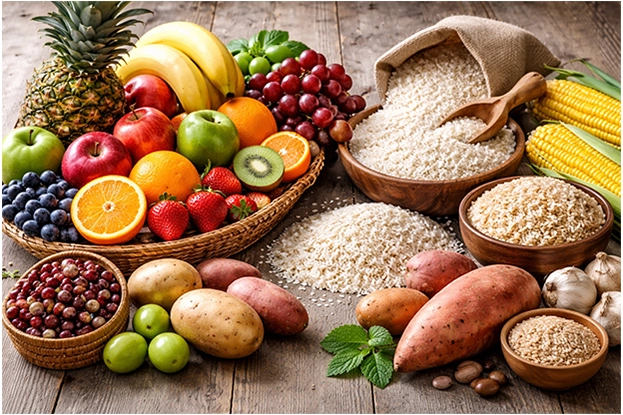
Fresh whole fruits (not juice), starchy vegetables like potatoes, rice.
Many people think you can eat all the fruits you want, but that’s not wise; fruits and starches both break down into glucose in your body, so too much of either is undesirable. Have fresh whole fruits as a treat (with the skin or pith if applicable). Apples are particularly good, and so are colorful berries; the color means phytonutrients and flavonols. As for rice, it works for laborers but not for most sedentary humans; limit intake to ½ cup per meal if you can, or substitute with Shirataki or legume-derived rice alternatives. Potatoes are better parboiled (thus, harder to digest) and drizzled with butter than fried or mashed.
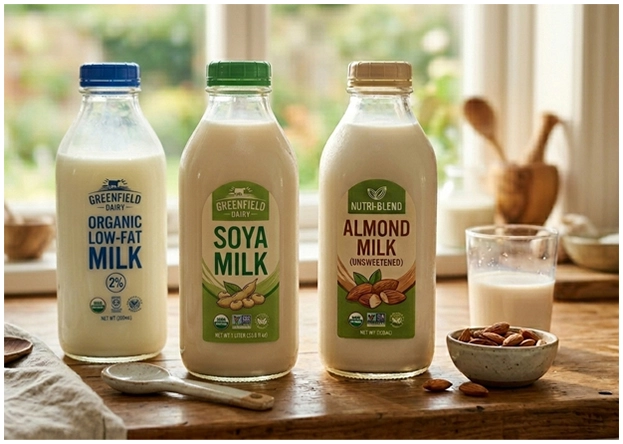
Low-Fat Milk
often has added starches and sugars to compensate. Alternative Milk (e.g., almond or soy milk) has the same issue, and often has just a tiny amount of the claimed original substance, but lots of added starches, sugars, and texturizers. Not worth the trouble. Drink regular whole milk.
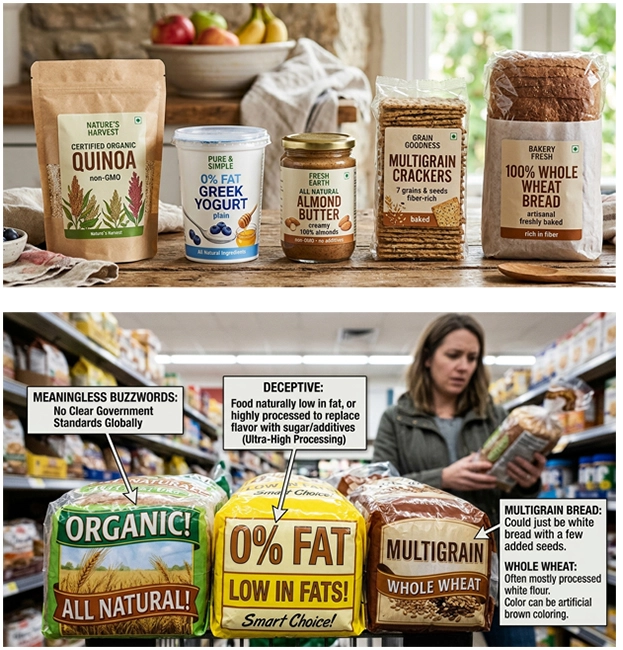
“Organic”, “0% Fat”, “All Natural”, “Multigrain”, “Whole Wheat”.
All these phrases are basically meaningless, with no clear government standards anywhere in the world. “O% Fat” and “Low in Fats” are especially deceptive because often applied to food that never had much fat in the first place, or that required so much additional processing that any possible benefit from reduced fat (see above, not that bad anyway) was greatly outweighed by Ultra-High Processing. As for multigrain bread, all that’s needed is to throw in some sesame seeds and it’s “multigrain”. “Whole wheat” often hides that only a little of it is that. Look instead for “100% whole wheat” which means that no white (i.e., Ultra-High Processed) flour was used, and the bread was made entirely with whole kernels containing all the fiber and nutrients it should have. Nor is color a good indicator, because some bread factories add brown color to fool you. Read the ingredient declarations.
- Processed cheese, American cheese, cheese food, singles, pasteurized process cheese, cheese spread. All of these are NOT cheese but “cheese altered with lots of chemicals”, and cannot legally (in most places) be labeled as simply “cheese”. They might be okay or not too bad, but for the full benefit and less chemicals, choose real cheese. Don’t be fooled by an ingredient list that merely mentions cheese as an ingredient. “Spreadable butter” is just butter with oil added, often an Ultra-High Processed seed oil (= bad).
- Peanuts are not “nuts” and don’t have the same health benefits as real nuts. Peanuts are legumes, but among the least desirable kinds, with not as much fiber. When choosing peanut butter, look for “No Sugar Added” and NO mention of “partially-hydrogenated” or “hydrogenated” oils in the ingredients. “Palmate”, “Stearic Acid”, and “Vegetable oil” are synonyms, just as bad.

Agave sugar
is in fact sugar with a higher glycemic index than regular table sugar. You are paying more to get a product that tastes funny and is much worse for your health.
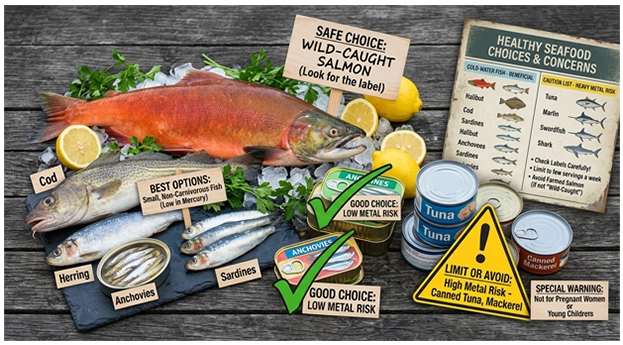
Cold-water fish,
which includes cod, salmon (better if wild-caught), halibut, herring, anchovies, sardines, and tuna. Fish has beneficial Omega-3, which is a building material for all cells, including brain cells. Unfortunately, tuna, marlin, swordfish, shark, and mackerel may have high concentrations of heavy metals (due to being higher up on the food chain). All the popular brands are likely to have heavy metals, though some brands are reported by Consumer Reports to have less. Meanwhile, any salmon that is not “wild-caught” was grown in open-sea pens and fed with unnatural food as well as antibiotics. Read labels carefully, and limit to a few servings a week. Probably better to avoid feeding small children and expectant mothers canned tuna (at all), or canned salmon (unless wild-caught). Smaller or non-carnivorous fish (sardines, anchovies, catfish, cod, tilapia, farmed shrimp) are safer for general consumption.
- Certain medications. Anti-cholinergic drugs act by damping neuron firing. Many common drugs fall into this category — dramamine, doxylamine, Benadryl/diphenhydramine, meclizine, first-generation allergy and bladder-control drugs. NSAIDs, including ibuprofen, are linked to dementia. Statins are mildly linked to dementia and can cause muscle weakness and atrophy generally, by dampening mitochondrial function; widely insisted upon by doctors worldwide, they indisputably lower blood cholesterol, but in 50 years of intensive and widespread use have not been clinically proven to lower mortality or prolong lifespan. The link to dementia is that cholesterol is actually the fuel needed for all brain function. Z-drugs, notably Zolpidem/Stilnox, are linked to dependency and dementia. ESPECIALLY AVOID overlapping use of several such drugs.
BEST FOODS, EAT OFTEN
- Apples. A lot of nutrients and fiber for less than 100 calories. Just about the only fruit that you should indeed eat “once a day, to keep the doctor away”.
- Eggs, shrimps. Decades of doctors just parroted that eggs and shrimps are bad for you because they contain cholesterol. First of all, cholesterol in food has not been shown to lead to higher cholesterol in blood. Second, cholesterol in blood has not been shown to lead to higher mortality. And third, cholesterol is the food your brain needs (and which your brain mainly consists of, chemically) so trying to lessen cholesterol may not be smart anyway. Eggs provide a lot of eating satisfaction and protein for very few calories (70-80 each).
- Avocadoes and avocado oil, olive oil. Coconut fruit, “water”, and oil.
- Most nuts — especially walnuts, pistachios, Brazil nuts, and almonds — all provide vitamins, minerals, and other nutrients, with high fat contents but typically high fiber. Avoid processed nuts with added sugars, brittle, or too much salt. Nuts are edible seeds which carry all the genetic information of the plant plus “instructions” leading to germination and rooting. Most fruits with a lot of “meat” have inedible seeds and rely on animals scattering them by accident, but those without much meat sometimes have hard shells and tasty seeds — nuts — to compensate.
- Sprouts are seeds that sprouted. Many sprouts are nutrient-rich, packed with protein, fiber, vitamins, minerals, amino acids, and plant enzymes. The ones commonly found in supermarkets are bean sprouts (mung bean), wheat, alfalfa, and sometimes broccoli. Many can be cultivated at home. An excellent article on this subject is: https://countrylifefoods.com/blogs/country-life-feed/sprouting-seeds
- Legumes are a large category of plant which includes white beans, peas, garbanzos, and lentils. In the Philippines, mung beans are widely eaten. Common legume derivatives or presentations are Filipino “monggos” (mung beans with some flavoring meat, in a soup), pork and beans, Spanish fabada, French cassoulet, and Mexican refried beans. Legumes are high in fiber, protein, and phytonutrients. Unexpectedly, rice and legumes together deliver all the proteins needed by a human body, which explains this widespread culinary combination around the world.
- Green leafy vegetables. Root vegetables, but some are better than others, notably beets, carrots, ginger, turmeric.
- Cruciferous vegetables, including broccoli, cabbage, Brussels sprouts, and cauliflower.
- Kefir and Kimchi. Many people are aware that yogurt contains probiotics, but most are not aware that most yogurts contain less than 10 kinds of beneficial micro-organisms, while Kefir and Kimchi have 40 or more kinds. Yogurt also often contains added sugars.
- 20-25 grams of fiber daily. This is a tall order for the modern diet (need 6 apples to meet the requirement, or several pounds of spinach), but adding fiber supplements can make up in large part. The fiber should be both soluble and insoluble. Chia seed is one commonly-sold insoluble fiber supplement. Soluble fiber includes psyllium, inulin, pectin, and corn fiber (also called resistant dextrose). There is some recent evidence that 10 grams of inulin daily is especially beneficial for reducing visceral fat.
Fiber Comparison
| Fiber Type | Inulin | Psyllium | Pectin | Soluble Corn Fiber |
|---|---|---|---|---|
| Solubility | Soluble | Mostly soluble | Soluble | Soluble |
| Fermentability | Highly fermentable | Moderately fermentable | Moderately fermentable | Partially fermentable |
| Prebiotic Effect | Strong prebiotic (supports bifidobacteria) | Mild prebiotic | Supports gut microbiota | Mild prebiotic effect |
| Effect on Cholesterol | Minor effect | Lowers LDL cholesterol | Helps lower LDL cholesterol | Neutral effect |
| Effect on Blood Sugar | May slow glucose absorption slightly | Stabilizes post-meal blood sugar | Slows gastric emptying and glucose absorption | Low glycemic; supports blood sugar control |
| Digestive Benefit | Promotes regularity | Adds bulk, relieves constipation | Soothes digestion | Gentle on digestion |
| Other Notes | May cause gas/bloating in high doses | Gentle, well tolerated | Found in fruits like apples and citrus | Well tolerated; used in fortified foods |
I want to Book My Stay at Plantation Bay Now!
© Plantation Bay Resort and Spa. All rights reserved. Design and development by Leox. | Font made from Web Fonts is licensed by CC BY 4.0